If you’re spinning up a new hosting startup, migrating a growing agency’s infrastructure, or just trying to organize your client server management, the first major architectural choice you hit usually isn’t about bare metal versus cloud. It’s about how you are going to bill for it.
For the better part of two decades, the default answer in the web hosting industry was automated, almost algorithmic: “Just install WHMCS and get back to work.”
It was the undisputed king of hosting automation. But if you have been paying attention to the infrastructure space over the last few years, you know that the default crown has severely slipped. As a developer and agency owner, I have migrated multiple projects, scaled digital infrastructure, and watched the billing software landscape shift dramatically.
Today, every single time I stand up a new venture or advise a reseller, I choose Blesta over WHMCS. It isn’t just a minor preference; it is a calculated business decision based on code architecture, security, and long-term financial sustainability.
Here is exactly why I abandoned the “industry standard” and why Blesta wins the hosting automation war every time.
1. The Hostile Pricing Squeeze (The WebPros Effect)
We cannot talk about the current state of hosting automation without addressing the elephant in the room: private equity.
When WHMCS was acquired and bundled into the WebPros portfolio (the same conglomerate that owns cPanel and Plesk), the writing was on the wall. What followed was a masterclass in captive-audience price gouging.
If you look at the pricing history, the inflation is staggering. Between 2020 and 2026, WHMCS prices exploded. The old “owned” perpetual licenses were entirely retired, forcing everyone into a subscription model. If you are a mid-sized host managing 10,000 clients today, the WHMCS Business tier will cost you nearly $400 every single month. Even their entry-level “Plus” self-hosted license, capped at a measly 250 clients, jumped to $34.95/month. They essentially punish you for growing your business.
The Blesta Counter-Approach: Blesta operates in an entirely different reality. They still offer a true Owned License (ranging from $350 to $500 as a one-time purchase) that gives you the software for life. If you prefer the monthly route, their Branded license is just $17.95/month.
The best part? Blesta’s plans support unlimited clients.
When you are trying to bootstrap a reseller hosting business or scale a digital marketplace, managing your operational expenses (OPEX) is crucial. Blesta allows you to forecast your billing software expenses for the next five years with 100% accuracy. WHMCS leaves you wondering what your invoice will look like next January.
2. Code Transparency: The Death of IonCube
This is where the developer in me gets incredibly frustrated with WHMCS.
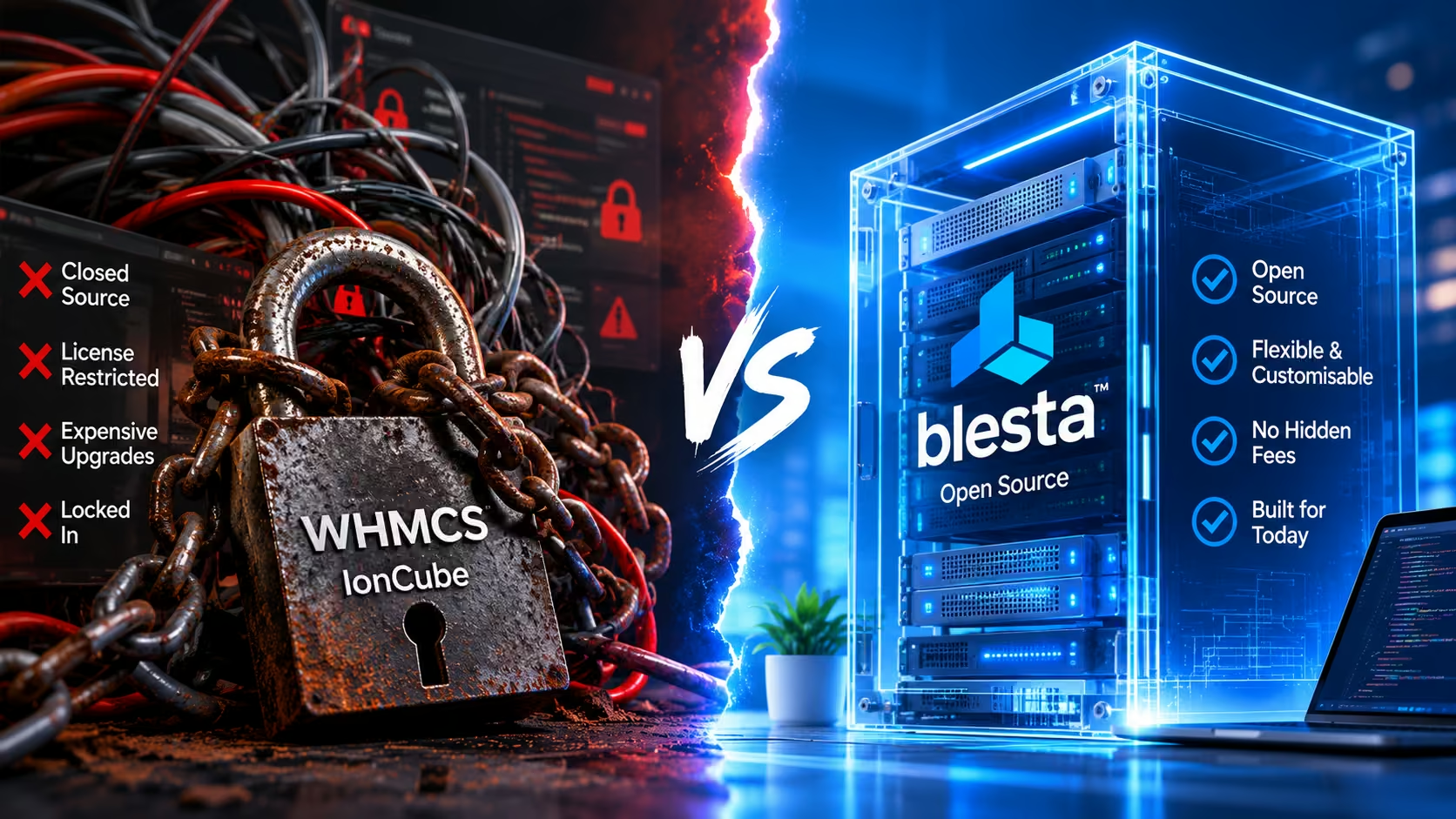
WHMCS is heavily encoded using IonCube. This means the core logic of the software is locked away in an encrypted black box. You cannot read it, you cannot audit it, and you certainly cannot modify it. If a core process breaks, or a payment gateway throws an undocumented error, you are completely at the mercy of their support desk. You are stuck waiting days for an engineer to look at your ticket while your clients fail to process payments.
The Blesta Advantage: Blesta is 99% open source. Aside from three tiny files dedicated solely to license verification, the entire MVC (Model-View-Controller) codebase is fully open, documented, and readable.
For a tech agency, this is an absolute superpower. If a third-party API integration fails, I can open the core PHP files, trace the logic, find the exact line causing the timeout, and write a hotfix in twenty minutes. I can build highly customized hooks, modify the database interactions, and tailor the software perfectly to my infrastructure. Blesta treats its users like developers; WHMCS treats its users like tenants.
3. Security Without the Obscurity
When you run a hosting automation platform, you are managing a honeypot. Your billing system holds client data, server root passwords, API keys for domain registrars, and active Stripe or PayPal tokens. Security is not a luxury; it is the entire foundation of your business trust.
For years, WHMCS has relied heavily on “security by obscurity” through its encoded files. However, the last few years have seen multiple high-profile compromises within the WHMCS ecosystem, particularly involving third-party themes (like HostX and CloudX) and silent patches pushed out without clear public advisories.
Because Blesta is open source, its security model is transparent. The codebase is constantly being audited by thousands of independent hosting developers around the world. When a vulnerability is found, Blesta issues clear, public security advisories and pushes patches immediately. You know exactly what was fixed and why. I sleep significantly better knowing that the software holding my server infrastructure keys can be actively audited by the community.
4. Native Multi-Company Architecture
As a hosting entrepreneur, your business rarely stays static. You might start by selling standard shared hosting under one brand, but a year later, you realize there is a massive market for high-ticket, managed WordPress hosting.
From a marketing perspective, you want these to be two completely different websites with different branding, different support emails, and different pricing tiers.
If you use WHMCS, doing this is a nightmare. You either have to purchase a second, expensive software license and run two completely isolated databases, or you have to buy hacky, third-party plugin modules that attempt to force WHMCS to recognize multiple brands.
Blesta was built from day one to handle this natively. Multi-company support is baked directly into the core.
From a single Blesta installation and a single admin dashboard, I can spin up multiple distinct hosting companies. I can route “Brand A” to one domain with its own logo and invoice templates, and “Brand B” to another. They share the same backend staff and payment gateways, but to the end-user, they are completely separate corporate entities. This feature alone saves growing agencies thousands of dollars in licensing and administrative bloat.
5. A Modern UI/UX and Developer Experience
Let’s be brutally honest: under the hood, WHMCS feels exactly like what it is—a massive, sprawling legacy product born in 2003 that has been patched, painted over, and bolted onto for two decades. The backend can be sluggish, the template logic relies on outdated Smarty variables, and writing custom modules requires navigating a maze of legacy documentation.
Blesta, on the other hand, is built on a highly structured, modern, object-oriented framework.
The interface is cleaner, faster, and infinitely more intuitive. Navigating between client profiles, service management, and billing invoices takes half the clicks it does in WHMCS. When it comes to frontend design, building a custom client portal (like the Hostra theme) is an absolute joy in Blesta compared to wrestling with the WHMCS template engine. The flat HTML structures integrate seamlessly, resulting in blazing-fast load times for your customers when they log in to manage their services.
The Final Verdict
Nobody denies that WHMCS has the largest market share. It has a massive marketplace of pre-built integrations, and if you have a highly obscure, localized payment gateway from a decade ago, somebody has probably written a WHMCS module for it.
But market share is not a substitute for architectural quality, and a monopoly is not an excuse for exploitative pricing.
When you choose your hosting automation platform, you are choosing a business partner. You are laying the foundation for your customer experience, your server security, and your profit margins.
Blesta offers a cleaner codebase, superior developer freedom, natively brilliant multi-brand scaling, and a pricing model that actually respects the entrepreneur. If you are building a modern web hosting business, protecting your revenue, and valuing clean technology, the choice isn’t even close. Blesta wins every time.