If you read the mainstream tech press in 2026, you would assume there are only three companies left on earth: Microsoft, Google, and Amazon. The prevailing narrative is that the generative AI boom requires such incomprehensible amounts of capital, hyper-scale GPU clusters, and dedicated nuclear power agreements that the independent web host has been entirely regulated out of existence.
The narrative insists that if you don’t have ten billion dollars to build a hyperscale datacenter, you have no place in the AI economy.
The reality on the ground is completely different.
While the hyperscalers are locked in a massive arms race to train the next generation of trillion-parameter models, a massive, highly lucrative vacuum has opened up beneath them. Small and medium-sized businesses, regional healthcare providers, and local law firms do not need to train foundational models. They need to use them. And more importantly, they are terrified of sending their proprietary data into the public cloud to do it.
This shift in consumer behavior is quietly fuelling a golden age for agile, localized hosting businesses. Here is exactly why the AI boom is playing directly into the hands of the independent infrastructure provider, and how you can position your hosting startup to capture the revenue.
The Legal Moat: Data Residency and "Sovereign AI"
To understand the local hosting opportunity, you have to understand the modern corporate fear of data leakage.
When a local financial advisory firm or a regional private clinic wants to deploy a customized Large Language Model (LLM) to summarize their internal documents or analyze patient histories, they hit an immediate regulatory wall. Privacy laws (like GDPR in Europe, POPIA in South Africa, and HIPAA in the US) strictly regulate cross-border data flows.
If that clinic pings a public OpenAI API, they are essentially transmitting sensitive local data to an offshore server farm. The legal liability is massive.
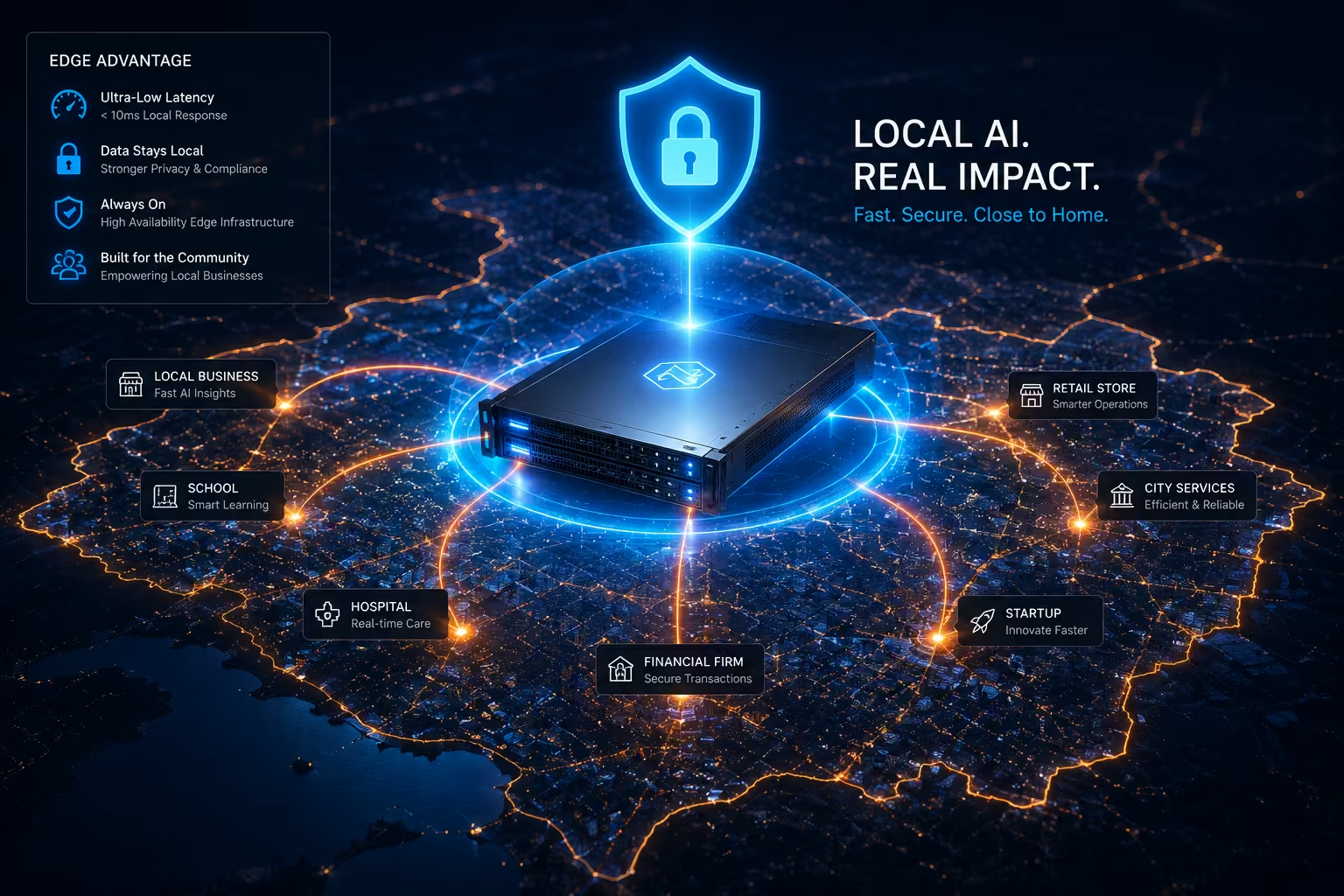
This has given rise to the biggest infrastructure trend of 2026: Sovereign Cloud and Digital Sovereignty. Enterprises and governments now mandate that their data must remain within their physical and legal jurisdictions. They want “air-gapped” or highly isolated AI environments where they have absolute certainty that their data isn’t being scraped to train a global model.
This is the ultimate moat for the local hosting provider.
Hyperscalers are fundamentally designed to operate globally, routing data through whatever region is most efficient. A local web host, however, can explicitly guarantee geographic data residency. You can look a local business owner in the eye and say, “Your vector database and your open-source LLM are running on a bare-metal server located exactly three miles away, governed exclusively by our local privacy laws.”
That localized trust is a premium product that hyperscalers simply cannot replicate.
The Physics of Inference: Winning at the Edge
The AI ecosystem is divided into two phases: Training and Inference.
Training an AI model requires thousands of GPUs running for months. Let the hyperscalers handle that.
Inference is what happens when a user actually asks the AI a question or triggers an automated workflow. Inference requires speed. As AI integrates into real-time industrial automation, financial modeling, and customer service portals, latency has become the enemy of performance.
If a local manufacturing plant is using AI computer vision to detect defects on a fast-moving assembly line, they cannot afford the 150-millisecond round-trip latency of sending that video feed to a hyperscale server on another continent. They need the computation to happen immediately.
This is driving the explosion of Edge Computing. Localized edge data centers and regional hosts are uniquely positioned to serve ultra-low latency AI workloads. By provisioning GPU-accelerated servers in regional hubs, independent hosts can offer inference speeds that centralized cloud regions simply cannot match. You aren’t selling general web hosting anymore; you are selling localized compute proximity.
The Hardware Pivot: High-Density Micro-Clusters
Capitalizing on this requires a slight pivot in how you view server provisioning. The days of packing 500 standard WordPress sites onto a single 10kW server rack are evolving.
AI workloads—even just running open-source models like Llama or Mistral for local clients—require a different kind of horsepower. We are seeing rack power densities jump from traditional 10kW setups to 100kW or even 300kW high-density configurations.
As a local host, your advantage is agility. Hyperscalers are dealing with massive supply chain backlogs and multi-year waiting lists for infrastructure build-outs. An independent hosting company can move swiftly. You can lease a high-density, liquid-cooled half-rack in a regional colocation facility, rack a few GPU-accelerated servers, and immediately begin selling dedicated “AI-Ready” bare metal instances to local tech agencies.
You don’t need a thousand GPUs. You just need a micro-cluster tailored perfectly for local development agencies who are building AI web apps and desperately need reliable, local server runtime.
Packaging the AI Infrastructure Product
How do you actually sell this if you are currently running a standard reseller or VPS operation? You stop selling “hosting” and start selling “ready-to-deploy environments.”
The modern tech agency doesn’t want to spend three days configuring Linux dependencies. They want push-button deployment. Here is how smart local hosts are restructuring their product tiers in 2026:
-
Managed Vector Databases: AI applications rely on vector databases (like Milvus, Qdrant, or Pinecone alternatives) to store memory and context. Offer managed, locally-hosted vector database instances with one-click provisioning.
-
Private API Nodes: Sell VPS environments pre-configured with open-source LLMs and API wrappers. The client buys the server, and you provide a private, local API endpoint they can plug directly into their software without writing command-line code.
-
High-Compute WordPress Stacks: AI plugins for WordPress are incredibly resource-heavy. They scrape data, generate images on the fly, and run constant background crons. Create a premium “AI-Optimized WordPress” tier that allocates dedicated CPU cores and high RAM specifically tuned to prevent these heavy sites from crashing under load.
The Billing Integration
Managing these high-ticket, high-resource products requires a robust billing automation system—which is why choosing a platform like Blesta becomes even more critical.
AI infrastructure is rarely a flat-rate game. A client might need massive GPU compute for a heavy data-processing weekend, and then scale back down to a standard CPU environment for the rest of the month.
Because modern billing platforms offer deep API integrations and module flexibility, you can tie your client billing directly to their metered resource usage. You can provision a dedicated edge server, assign the IP, and automate the provisioning of the AI stack seamlessly. The client gets a beautiful, modern dashboard to manage their localized AI infrastructure, and you get a high-margin, recurring revenue stream.
Conclusion: Stop Competing, Start Localizing
The hyperscalers won the cloud storage wars a decade ago. Let them have it.
The AI infrastructure boom is an entirely different battlefield. It is defined by digital sovereignty, edge-node latency, and data privacy. Those are arenas where massive, faceless corporations operate at a distinct disadvantage.
As a local infrastructure entrepreneur, you have the agility to spin up bespoke GPU hardware, the legal positioning to guarantee data residency, and the brand trust to look your clients in the eye. The AI gold rush isn’t about building the smartest artificial intelligence; it is about providing the secure, localized pickaxes and shovels for the businesses that are.
Position your hosting company at the edge, lock down your local data privacy offering, and watch your profit margins scale.